
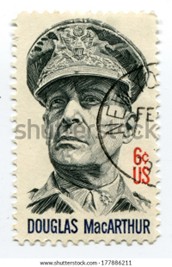
Example 1 of 3: General Douglas MacArthur
General Douglas MacArthur had a great strength—he was a decisive, strong, skilled general of World War II and post-war governor of Japan (and by, extension, Asia). The book American Caesar presents MacArthur as just that: an American version of Julius Caesar. Clearly MacArthur is among the finest soldiers ever fielded by America. At 38 years of age, he was the youngest division commander in the army.
In World War II, MacArthur led the effort in the Pacific. Commanding a severely under-staffed allied army with little air or naval support, he carefully shepherded his resources. Rarely contesting the Japanese where they were strong, he struck small islands where they were weak, slowly retaking the Pacific.
After World War II, he served as viceroy of Japan. A non-attender of church, the general is reported to have read the Bible every day. At the end of the war, he called for 1000 missionaries to come to Japan.
Korea In 1950, the North Koreans invaded South Korea. A plan seized MacArthur. It was bold. Audacious! Pure MacArthurism. Invade the enemy north of the southward advancing Communists, at the mid-section of the nation, drive northeast across the peninsula to the opposite ocean and cut off the retreating North Korean army.
Almost no one agreed with him. Navy brass said one sunken ship would block the harbor. There was no natural beach to accommodate a normal amphibious landing. Tides fluctuated as much as thirty-two feet where MacArthur proposed landing his force. The tide was only high enough for a landing three days in a two-month period.
To MacArthur, the alternative was a “beef-cattle-in-the-slaughterhouse” type of war up the peninsula with unacceptably high casualties. The horrendous slaughter of World War I battles changed the attitudes of military thinkers – only mediocre commanders tried frontal attacks anymore.
Drama King In Tokyo on August 23, 1942, one officer after another took the floor to explain why a landing at Inchon wouldn’t work. Then the general spoke. Later one officer said, “If MacArthur had gone on stage you never would have heard of John Barrymore.”*
On September 15, 1950, 13,000 Marines poured through Inchon against soft resistance, suffered only twenty-one dead and started the drive east and north toward the Yalu River. If before Inchon, MacArthur was “untouchable,” now he was a god. The general’s bold, arrogant plan had worked brilliantly. One of the worst defeats in American military history had, overnight, been turned into a stunning success.
Over-Confident While Under-Informed But at 70 years of age, grand old man didn’t know he was out of miracles. President Harry Truman was leery that China would support her vassal. The American Caesar was supremely confident that if China entered the war, he would deal them a crushing blow that “would rock Asia and perhaps turn back Communism.”**
But the China he knew didn’t exist any longer. “MacArthur had spent no time studying the Chinese army nor the tactics by which Mao had defeated Chiang Kai-Shek.”+
At the time, he was assuring Truman that he could land a knock-out punch to China. Should China enter the war, there were probably 130,000 Chinese soldiers in North Korea preparing for a counter-attack – and they still believed in frontal attacks. Their camouflage was so good and MacArthur’s intelligence so bad that their presence was unnoticed.
How had MacArthur reached such a point of non-awareness?
Pride In World War II, MacArthur had said “I shall return” – not “we shall return.” We all need a healthy degree of ego strength to compete in life and survive. The brilliant career of MacArthur had grown MacArthur’s pride beyond health into à non-health. What success was to MacArthur, anabolic steroids are to some athletes. A drug.
The General had not been home in thirteen years. Twice President Truman invited him home to receive the appreciation of a grateful nation. MacArthur declined. Since Truman felt a president’s suggestion was akin to an order, he was furious and felt the old soldier was holding out for the best political timing. MacArthur’s reason, however, revealed more pride than political moxy: “If I returned for only a few weeks, word would spread through the Pacific that the United States was abandoning the Orient.”++
Disobedient The Koreans slipped away north, eluding MacArthur’s grasp, so he met little resistance driving toward the Yalu River, the border of Manchurian China.
His orders were to stay away from the Yalu, but in an effort to capture the escaping North Korean army, he disobeyed. “Almost immediately MacArthur, exceeded his authority by ordering the bombing of North Korean airfields.
In October, Truman answered his own nervousness about MacArthur with a meeting on Wake Island. Well before that meeting, Truman penned the following note about MacArthur:
“And what to do with Mr. Prima Donna, Brass hat, Five Star
MacArthur. He’s worse than the Cabots and the Lodges –
they at least talked with one another before they tell God
what to do. Mac tells God off.” #
As MacArthur’s troops continued north, something ominous was in the air. Almost overnight, the enemy vanished. Fearing that the Joint Chiefs would stop him, MacArthur became selective in what he told them.
He was known by his peers as one who manipulated the information sent back to Washington to justify the plans he intended to carry out.
The weather turned cold. The wind-chill factor drove the mercury to 20 below zero. Rifles froze, as did batteries in vehicles. Chinese soldiers, who came in waves, were not to be denied. While the tide was turning against America, MacArthur remained in Tokyo, unwilling to acknowledge that he was on the defensive.
By November 28, 1950 it was clear that this was an epic disaster and that the great MacArthur had been out-generaled by the Chinese.
Pride drove MacArthur to offer Truman only two opposite scenarios: (1) enlarge the war, including fighting China, but which he was sure he could win, or (2) an American defeat. MacArthur seemed willing to propel the United States into an all-out war with China, possibly the Soviet Union and ignite World War III. In Washington, political and military leaders no longer trusted MacArthur to obey orders. The emperor had no clothes. The man who had built a brilliant career by obeying and being obeyed failed in his supposed strong suit.
Knowing that Truman’s administration was planning to announce on March 24 that it would seek a cease-fire, he pre-empted it and taunted the Chinese. Truman had to fire him. His strength had become his weakness, but he didn’t see it.
Truman wanted to send a private messenger to MacArthur, but news leaked out and he heard the inevitable on the radio.
Welcomed home to thunderous ovations – 100,000 met his plane in Hawaii, 20,000 met him in San Francisco. His speech to Congress was powerful, theatrical, manipulative and wonderfully selective with the record. He claimed the Joint Chiefs agreed with his policies in Korea. David Halbertstam in The Fifties said of that claim it was “a bold-faced lie” (Page 45). “MacArthur’s greatness intoxicated him to the point that he did not know when to retire and pass the baton” (Page 35).
Watch out. What we pride ourself on, if pressed too far, can become our downfall. Don’t let strengths become weaknesses through expecting too much from them. MacArthur never acknowledged that his strength had turned to blind weakness. He never faced his personal reality. Let’s face ours.
* The American Caesar ** page 32, + page 36, ++ page 32, # page 36.
Recent Comments