
Counter-culture, a term of our day, was also a reality of the Judges period. All of the cultures around Israel had kings. Israel did not. Why?
To understand why, let’s back up and think about the context—the Old Testament. Three-quarters of the Bible is the Old Testament. Of the 1094 pages in my Bible, guess where the New Testament starts? Page 851, yet the O.T. is not well-known. It has the reputation of being long and dull and having little to do with our spiritual lives today.
CONTEXT Abraham, Isaac & Jacob–approximately 2166-1850 B.C.–are well-known and lived before the Judges period. Then came the 400 years of bondage in Egypt. The united monarchies of Saul, David & Solomon–approximately 1050 – 940 B.C–also well known—came after the Judges Period. But the Judges Period is not well known.
Israel as a nation began in 1446 B.C. at Mt. Sinai (Exodus 19 & 20). The Old Testament ceased reporting Israel’s history around 450 B.C., so we have about 1000 years of Hebrew history reported in the Old Testament.
With 78% of the Bible being the O. T. and of that, one-third of the time–340 years being the Judges period–it is worth understanding. While the names of Gideon, Samson, Samuel, and Jephthah are well known, Christians today are not as clear on understanding what God was doing in the time of the judges or able to see what God wanted to accomplish.
JUDGES were short-term leaders who often won a military victory and presided over a period of peace. Judges 2:16 refers to a “judges period;” Ruth 1:1 says, “Now it came to pass in the days when the judges ruled. . . ;” and II Samuel 7:11 tells us, “Since the time that I commanded judges to be over My people Israel.”
There were 14 judges; eight rated as major and six are viewed as minor (6), based generally on: (1) how much print was awarded in Scripture and (2) whether or not they were the agent of a military deliverance.
Since God created this Judges period (1390-1050 B.C.), it must be instructive for later generations, given that it constitutes one-third of the whole Old Testament.
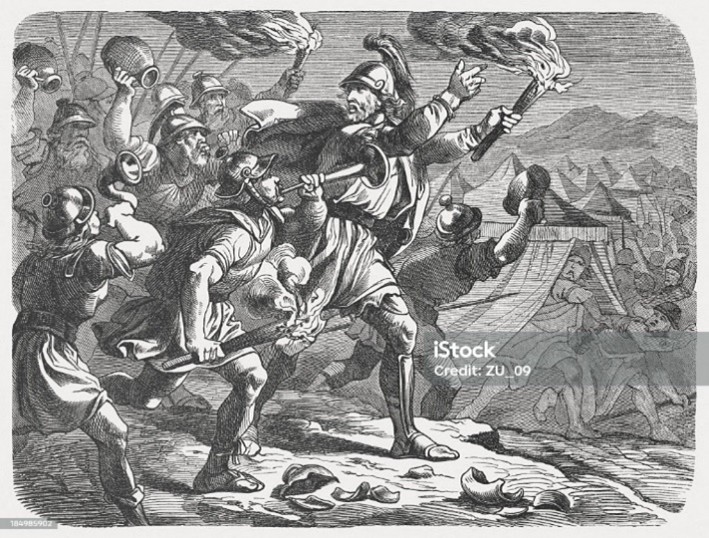
CYCLE Judges were temporary leaders who arose to call people back to God and, if necessary, lead in a victorious military campaign. We see this cycle in Judges six times. The people sinned, forgot God, lost their way, and plunged deep into sin. God had mercy on them by sending them a Judge (Samuel, Ehud, Gideon, Samson) who brought a victory and then guided an era of peace.
It is gracious of God to rescue His people. But it was not easy. Judges fought sin. Fighting sin in the nation then was like running for president now on a platform of a balanced budget and paying off the national debt–not much appeal. It is easier to let future generations pay for what we want to spend on ourselves now.
After sin had been ignored for a long time, and the Jewish people had lost contact with God and wondered where He was–and generations had been destroyed in judgment, many did not understand why. Sin brings confusion. The work of fighting sin is important, though unpopular.
The second thing Judges did was achieve military deliverance. This gets most of the attention in Judges. God allowed a judge to lead a citizens’ army to overthrow the Philistines, Moabites, Ammonites, or whomever.
PREPARATION Imagine that it is 1390 B.C. The conquest was over (capturing the Promised Land as reported in the book of Joshua). Joshua is about to die. Think about the preparation God had invested in this moment in Israel’s history. He had:
- Worked in and through Abraham’s life
- Multiplied Israelites while they were in Egypt to a nation-sized population
- Given the nation the mighty Moses to lead them out of bondage
- Performed 10 miracles to liberate them
- Opened the Red Sea for their exit, killing pharaoh’s chariots
- Given them His law and adopted Israel as His chosen people (Exodus 19 & 20)
Israel was to be God’s model people to show the world what a nation could be like. A land rich in natural resources and the ideal government! God wanted Israel to put Him on display. To attract other nations to the worship of the one true and living God. The Judges period would be the time in history when His ideal form of government would be put into action and be on full display.
Credit: This article is a summary from Dr. Leon Wood’s The Distressing Days
of the Judges; Zondervan, 1975
Recent Comments