
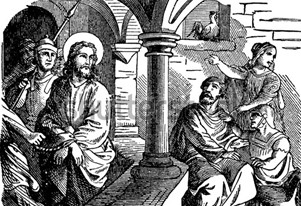
Example 2 of 3: Peter
You’ve met people who were so fastidious they had become prisoners of their own self-discipline and urge to organize. Others so spontaneous they do not plan.
Suppose a bridge needed to be built some distance away, and we considered two different construction companies to build it. We maty see both responses.
Mr. Order—Since Jesus warned, “Count the cost and know you can finish, or do not start” (Luke 14:28), once company withdrew; did not offer a bid, imagining many problems and deciding he did not have what it took to get the job done.
Mr. Spontaneous would throw together a low, incomplete bid that would result in him losing money.
Planners versus spontaneous. Either strength—when carried too far–becomes weakness.
In Peter, a disciple of the Lord Jesus, we see both reactions. The Master warned that He was about to be crucified. Spontaneous Peter leaped to His defense, believing he would defend the Lord to the death (good for Peter). And all the disciples said they would too (Matthew 26:35, Luke 22:33, 34).
For a while, Peter’s actions matched his words. When Jesus was arrested, Peter drew his sword. Ready to do battle, he at least cut off one ear (Matthew 26:51). Let’s credit Peter for bravery–he stood up to the whole mob to make good on his claim of loyalty.
But in the next few hours his over-confident, spontaneity betrayed him—three times he denied he even knew Jesus. Then came that terrible verse of painful self-discovery: “Just as he [Peter] was speaking [denying he knew the Savior] the rooster crowed. The Lord turned and looked straight at Peter” (Luke 22:60 and 61).
Spurgeon points out how compassionate the Lord was to Peter in that moment. Had He spoken, the relationship would have become known, and Peter might have joined Jesus on a cross. By merely looking instead of speaking, Jesus Christ was protecting Peter.
Peter found he wasn’t what he hoped or thought. A shocking discovery most believers eventually experience. We imagine ourselves honorable, right and caring, but find we are less.
He was accustomed to speaking up for the Lord, answering questions, and leading others. Peter’s strength became his downfall. That role of leadership set him up to discover himself. In the clutch, Peter buckled. So have we. But in Peter’s case, this faith-failure became the making of him. He arose to be a capable, compassionate leader. Will we? schemed, and he could have easily over-ruled and nullified what they did. But God allowed the deception to take its course.
Recent Comments