
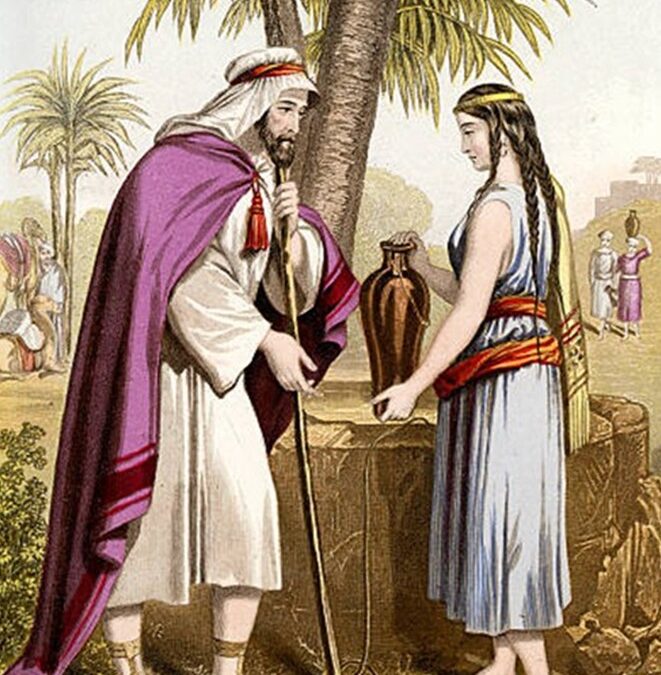
Example 3 of 3: Rebekah
Rebekah (Genesis 24) was to figure large in the family of Jacob; hence in the whole book of Genesis.
She was up for adventure. Asked whether she would go and marry a distant relative (pictured at left as Rebekah watered the camels of Abraham’s unnamed servant) she had never met, she answered, “I will.”
She left, apparently confident in God’s plan for her life, a positive mental outlook, and secure in her gifting from God. She never returned; never saw any of her family members again. Quite a woman! Strong. Filled with faith! I imagine her being asked if she was ready for a totally new life, I further imagine her saying, “Bring it on.”
Genesis 25:23 tell us that after two decades of marriage, two nations were in Rebekah’s womb, and the older (Esau) would serve the younger (Jacob).
In Gensis 27 Isaac was older and in declining health. Poor eye-sight and lacking in confidence, I believe he had become dependent upon the energetic, capable Rebekah.
When Isaac was about to give his patriarchal blessing to Esau, Rebekah likely felt that she had what we would regard as Biblical authority (Genesis 25:23) for seeking to get the blessing for Jacob.
It was precisely here that the strength of her initiative (leave all that she knew to marry a man she did not know; take the lead in parenting, care for aging Isaac), which had served her so well in the past, pushed her toward weakness. Pushed her toward lying and deceiving her husband. Pushed her toward manipulating the greatly reduced, mostly blind, aging Isaac.
Her strength became her weakness. It takes a clear awareness of who we are in Christ and knowing what God has given us (See Romans 12:3 & 6) and what He has not given us (John 3:27) that we need to correctly evaluate our worth on the open market for normal daily living out in society.
We need to seek humbly see God’s guidance as to how far our gifting can / should carry us because our sin natures lead us to assume we are smarter than others, worth more in the public arena, and know about a given issue.[1]
Summary of three articles:
Example 1: Peter did not know himself (first example of strength turning to weakness).
Example2: General Doughlas MacArthur over-estimated his own abilities. Pride led him to believe he knew best. He didn’t.
Example 3: Rebekah slipped to deep manipulation and dishonesty, over-estimating her grip on God’s will (“Jacob must get the blessing and I am the only one who sees this, so I have resort to scheming to fulfill God’s prophecy”).
A word to the Rebekah’s of our day. It is not right to do wrong to do right. That is, it is not right to do wrong (lie, deceive, and manipulate) to do what we think is right (get the blessing for Jacob).[2]
[1] Some who are self-confident need humility . . . but others who are insecure are apt to incorrectly conclude from this article that they need to be more humble and submit to others (when in reality, they need to be more assertive and strong).
[2] I have mused about what God might have done had Rebekah not manipulated the blessing. In other words, how could Jacob have gotten blessing without resorting to deception and lying? (1) Maybe the older could have served the younger (as prophesied), even if he did not have the formal blessing. (2) Maybe Esau would not have been able to get game to make “tasty food” for his father. (3) Maybe God would have sent Isaac a heart attack before he gave the blessing to the wrong son. God would have gotten it right had not Rebekah and Jacob schemed, and he could have easily over-ruled and nullified what they did. But God allowed the deception to take its course.
Recent Comments